


October’s Jobs Report: What Frontline Employers Need to Do Before 2027
By Alysia Baker Eve, VP of Go-to-Market, Array Corp
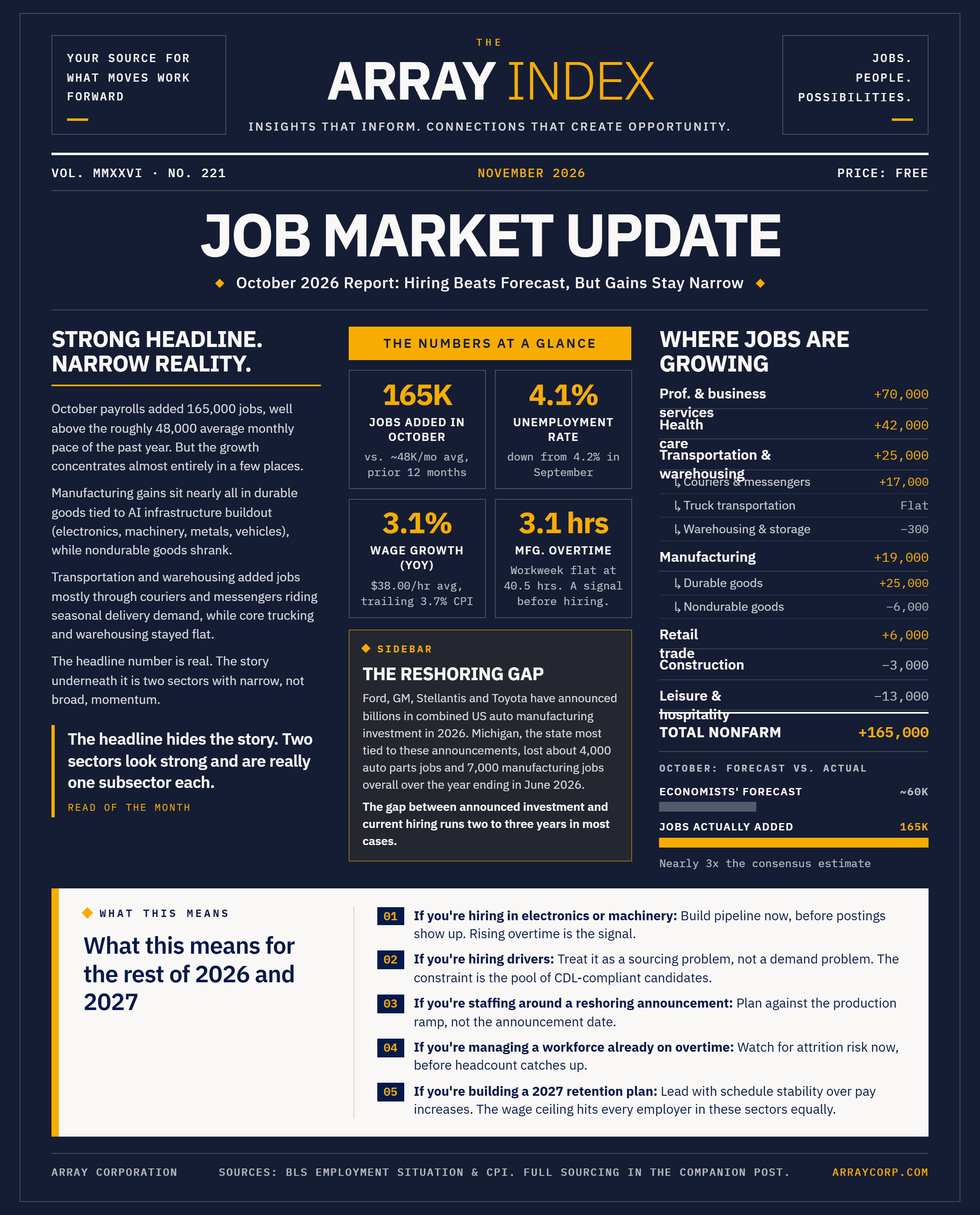
October payrolls came in at 165,000, well above the roughly 48,000 average pace of the past year, according to the BLS Employment Situation report. The jump looks positive going into peak season, but pull the number apart by sector and you get three very different pictures.
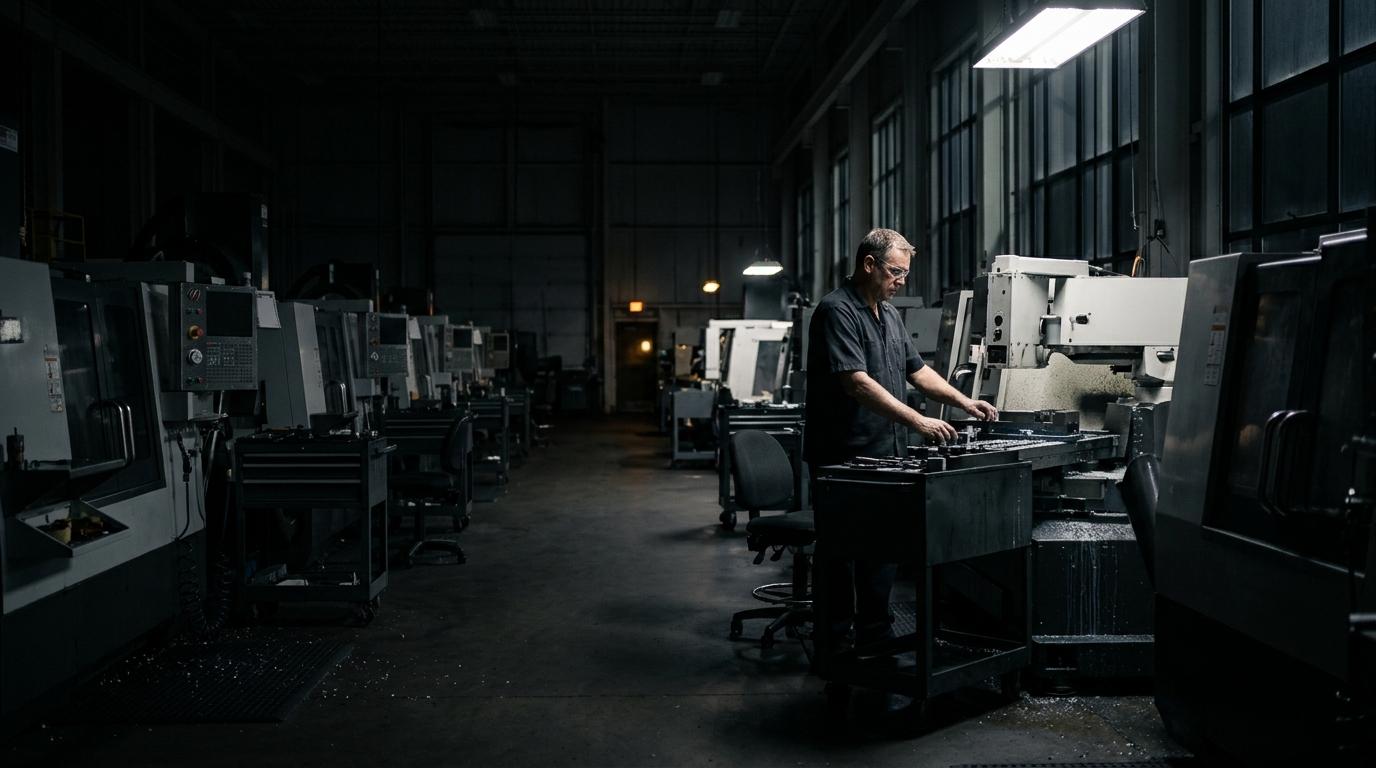
Manufacturing Jobs: The Growth Is Real But It’s Narrow
Manufacturing added 19,000 jobs in October and has added 101,000 since bottoming out in December 2025. Almost all of it sits in durable goods tied to AI infrastructure buildout: electronics, machinery, primary metals, motor vehicles. Nondurable goods shrank.
If you’re hiring for semiconductors or machinery, this is a real tailwind. If you’re anywhere else in manufacturing, this jobs report describes a dynamic that doesn’t align with your daily experience.
The number worth watching is overtime. Manufacturing overtime ticked up to 3.1 hours while the regular workweek held flat at 40.5. Employers are squeezing more out of current staff before they commit to new hires. That pattern usually converts to actual headcount growth within one or two quarters, if demand holds.
Auto Reshoring: The Investment Is Real, The Hiring Timeline Is Longer Than Anyone’s Admitting
Ford is reshoring Lincoln production. GM has committed roughly 6 billion dollars including an Orion Township expansion. Stellantis is making its largest single US investment in a century. Toyota is shifting Tacoma production from Mexico to Texas. All of that is real and documented.
But the headlines can be misleading. Michigan lost about 4,000 auto parts jobs and 7,000 manufacturing jobs overall over the year ending in June 2026, despite being the state most tied to these announcements. The broader sector shed about 72,000 jobs nationally after April tariff changes, partly because stacked tariffs on parts, aluminum, and steel made building a car domestically more expensive than importing one.
Ford’s own CEO, Jim Farley, has said the missing piece in the reshoring story isn’t capital, it’s the workforce. One economist’s take is blunter: Moody’s Analytics chief economist Mark Zandi has said whatever production comes back will be heavily automated, with few jobs attached, according to Fortune’s reporting on the Detroit manufacturing slowdown.
Transportation and Warehousing Jobs: One Sector, Two Opposite Stories
The sector added about 25,000 jobs in October. Seventeen thousand of those were couriers and messengers riding seasonal delivery demand. Core trucking was flat. Warehousing was flat to slightly down, and that flatness has real causes behind it.
Warehouse and fulfillment postings didn’t surge into peak season the way most coverage assumes. They held almost dead flat from August through October, roughly 1,050 new postings a day for three straight months, across more than 28,000 distinct companies, according to Array’s analysis of job posting data. Part of that flatness is automation. Rockwell Automation reported warehouse and ecommerce automation sales up 30 percent year over year, with raised guidance for the rest of the fiscal year, so some of what would have been seasonal headcount in past years is getting bought as equipment instead. Part of it is a labor pool that’s genuinely looser than last year. Warehousing and storage employment was down 1.2 percent year over year as of September, and transportation sector unemployment sat at 4.7 percent that month, up from 4.3 percent a year earlier. The most recent October reading eased slightly to 4.0 percent, still above the national rate.
At the same time warehousing looks loose, trucking looks the opposite. The American Trucking Associations puts the driver shortage at roughly 82,000 drivers, the first shortage in four years, driven mostly by a March 2026 CDL rule that tightened eligibility and pulled drivers out of the pool. But the industry itself is split on how serious it is: ATRI’s own annual carrier survey found “driver shortage” dropped out of the top 10 industry concerns for the first time in 21 years. Two adjacent job categories in the same sector, moving in opposite directions at the same time. Lumping them together as “transportation and warehousing added 25,000 jobs” hides the dynamics, which are important to understand on their own.
A looser warehouse labor pool cuts both ways. It’s easier to fill a shift. It’s also easier for a worker to leave one job for a better offer three days later, especially during peak when every warehouse within driving distance is hiring for the same six weeks. Every no-show and early quit means a new round of sourcing and onboarding, plus lower output while the replacement ramps up, on margins that don’t have much room to absorb constant churn.
Wage Growth: The Raise Isn’t Doing What It Used To
Wage growth held at 3.1 percent year over year. Inflation has now posted three straight months at 0.4 percent or higher, per the BLS CPI release. Real hourly earnings were flat in October, the third month running.
Every employer in these sectors is hitting the same ceiling on pay. When nobody can out-raise the competition in any meaningful way, the thing that actually wins frontline talent stops being the next quarter-point bump and starts being predictable hours and schedule stability.
Retention and Turnover: The Other Side of Every Number Above
The same data tells a retention story too, and it’s arguably the more urgent one.
Manufacturing overtime at 3.1 hours is a hiring signal, but it’s also a burnout risk for the people already on the line. If headcount doesn’t catch up within the next quarter or two, expect attrition to rise among exactly the workers you’re trying to avoid losing while you wait on new hires.
Trucking has a documented turnover problem running in parallel with its hiring shortage. One industry survey found 58 percent of drivers are actively job hunting even as capacity tightens industry-wide. That means carriers are competing to keep the compliant drivers they already have, not just to find new ones in a shrinking eligible pool.
And the wage ceiling cuts the same way everywhere. Real hourly earnings have been flat for three months running. That’s a building retention problem. Workers losing ground in real terms rarely quit loudly, they just leave for a dollar more somewhere else.
What to Do With This Before 2027
If you’re hiring in electronics or machinery: start building pipeline now, before the postings show up. Rising overtime is your signal. Wait for the listing and you’re already behind.
If you’re hiring in any other manufacturing subsector: don’t oversell this report to yourself. It’s not describing your hiring environment.
If you’re hiring drivers: treat this as a sourcing problem, not a demand problem. The constraint is the pool of CDL-compliant candidates, so expand beyond the usual job boards to find eligible drivers instead of just posting more openings.
If you’re managing a workforce already stretched on overtime: start planning for attrition now, not after headcount catches up. Look at incentives, productivity visibility, and start developing strategies to build a retention plan that doesn’t just throw $.50/hour on your wage costs.
If you’re building a 2027 retention plan: lead with schedule stability, predictable hours, and incentives tied to productivity. The wage ceiling is hitting every employer in these sectors equally, so pay alone won’t differentiate you.
What to Watch Over the Next Six Weeks
November’s jobs report lands December 4. CPI follows December 10. The Fed’s last rate decision of the year is December 9, right in between. This is the most data-dense week left in 2026, and any surprise in either report will move the ground under 2027 plans fast.
Beyond that, three things to track.
Manufacturing overtime converts to new hiring in the next report or just keeps climbing.
Michigan and other reshoring states keep losing auto jobs even as investment announcements continue.
Courier employment gives back its gains once the holidays end, which will tell you how much of October’s transportation number was ever real.